
Prophet Muhammad 

They, who are asleep and pleased by dreams from him.
How beautiful what has been said about his reality!
Your light is everything and everything else is particles.
O Prophet, your soldiers in every time are your Companions!
The Shaykhs of the Naqshbandi Order are known as the Golden Chain because of their connection to the highest, most perfect human being, Muhammad , the First to be created, the First to be mentioned, the First to be honored.
When Allah ordered the Pen to write, it asked, “What shall I write?” and Allah said, “Write ‘La Ilaha Ill-Allah.’” The Pen wrote “La Ilaha Ill-Allah” for seventy-thousand of Allah’s years and then it stopped. One of Allah’s days is equal to one thousand of our years. Then Allah ordered it to write again, and the Pen asked, “What shall I write?” and Allah answered, “Write Muhammadun Rasul-Allah.” And the Pen said, “O Allah, who is this Muhammad that You have put Your Name next to his name?” Allah said, “You must know that if it were not for Muhammad I would not have created anything in Creation.” So the Pen wrote Muhammadun Rasul-Allah for another seventy-thousand years.
When did Allah order the Pen to Write? When did the Pen Write? When did that writing of “La ilaha ill-Allah Muhammadun Rasul-Allah” occur? No one knows. The mention of the name of the Prophet by Allah, Almighty and Exalted, is something which happened before the creation of anything, and its reality occurred in pre-Eternity. That is the reason the Prophet mentioned, “kuntu Nabiyyan wa adamu bayni-l-ma’i wa-t-tin” – “I was a Prophet when Adam was between water and clay.”
He is the Perfect Human Being. He is the Seal of all prophets and messengers. What can a weak servant say in order to honor the Master of Messengers? If it were not for him, no one would ever have known Allah, Almighty and Exalted. Never would the fabric of the universe have been woven into existence as it has been woven. Therefore the pen cannot describe the most perfect of the Perfect human beings, the Master of Masters, the King of Kings, the Sultan of Sultans of the Divine Presence.
He is the Heart of the Divine Presence. He is the Heart of the Unique Essence. He is the Sign for Oneness and the Sign of Oneness. He is known as the Secret of All Secrets. He is the only one addressed by Allah Almighty and Exalted, because he is the only one considered Responsible in the Presence of Allah who said, “Were it not for him I would not have created any of My creation.” All of the creation was given to the Prophet as a divine gesture of honor from Allah, Almighty and Exalted. Therefore the Prophet is responsible for that creation which is his honor and his Trust. For that reason he is the only one to be addressed in the Divine Presence.
The singular status of the Prophet is the heart and the Essence of the phrase of tawheed [La ilaha ill-Allah Muhammadun Rasul-Allah] and the foundation of Sufism. The Prophet is the “one soul” mentioned in the Qur’anic verse, “[O Mankind] Your creation and your resurrection is in no wise but as an individual soul” [31:28]. It is also the Prophet who is the “single life” represented in the verse, ”If anyone slew a person… it would be as if he slew the whole people: And if anyone saved a life, it would be as if he saved the life of the whole people.” [5:32]
The Prophet , moreover, referred to his responsibility in the hadith: tu`radu `alayya a`malakum, “All your actions are shown to me every day. If they are good, I pray for you; if they are bad, I ask Allah’s forgiveness for you.” That means that the Prophet is the one who is responsible towards God for his Community. That is why, as we said, he is “the only to be spoken to.” It is the meaning of Intercession. Allah refers to this intercession in the verse, “If they had only, when they were unjust to themselves, come unto thee and asked Allah’s forgiveness, and the Messenger had asked forgiveness for them, they would have found Allah indeed Oft-Returning, Most Merciful” [4:64].
His honorable biography and his blessed speeches and actions can never be encompassed in a book. But we can say that he is Muhammad ibn Abdullah ibn Abdul Muttalib ibn Hashim and that his lineage goes back to Ibrahim . He was born in Makkah al-Mukarrama on a Monday, the 12th of Rabi`ul Awwal, 570 CE, in the Year of the Elephant. His mother, Sayyida Amina, when she gave birth to him, saw a light coming from her that turned all darkness into light as far as Persia. When he was born, the first thing he did after coming from his mother’s womb was to fall into prostration. His father died before he was born. He was nursed by Thuayba and then by Halima as-Sa`diyya, with whom he stayed for four years.
While returning with him from a visit to his uncles in Madinat al-Munawwara (at that time Yathrib), his mother fell sick and died. He was six years old. His grandfather raised him for two years, until he also died. Orphaned three times, he went to live with his uncle, Abu Talib. Allah Almighty and Exalted ordered the Angel of the Trumpet, Israfil  to accompany him at all times until the age of eleven years. Then Allah ordered Jibril to accompany him and to look after him and to keep him in his safekeeping, and to send to his heart heavenly and spiritual Powers.
He traveled with his uncle to Sham (Damascus). On their way they passed by Basra where a monk named Buhaira, living in a monastery nearby, told his uncle, “Take him back, it will be safer for him.” At that time he was twelve years old. Years later he traveled again to Sham with Maysara, to trade on behalf of the Lady Khadija  . They were very successful. Maysara told Khadija about his miraculous powers and his business acumen and she became interested in him. She proposed marriage and he accepted her offer. He married her when he was 25 years of age and she was forty.
He was known throughout his tribe as as-Sadiq al-Amin, the Truthful and Trustworthy One. When he was 35 years of age, the Quraish Tribe was renovating the House of Allah, the Ka’aba. They disputed among themselves as to who should put the sacred Black Stone (hajaru-l-aswad) in its place. They finally came to an agreement that the most trustworthy person should replace it, and that person was the Prophet .
At that time inspirations and revelations were coming to his heart. He was always in a state of spiritual vision and insight, but he was not authorized to speak about it. He preferred to be alone and used a cave in a mountain called al-Hira for contemplation and meditation. He sought seclusion as the means to reach the Divine Presence of Allah Almighty and Exalted.
He avoided all kinds of attachment, even with his family. He was always in meditation and contemplation, afloat on the Ocean of the Dhikr of the Heart. He disconnected himself completely from everything, until there appeared to him the light of Allah Almighty and Exalted, which graced him with the condition of complete intimacy and happiness. That intimacy allowed the mirror of revelation to increase in purity and brightness, until he attained to the highest state of perfection, where he observed the dawning of a new creation. The primordial signs of beauty shone forth to spread and decorate the universe. Trees, stones, earth, the stars, the sun, the moon, the clouds, wind, rain, and animals would greet him in perfect Arabic speech and say, “as-Salam ‘alayka Ya Rasul-Allah” — “Peace be upon You, O Prophet of God.”
At forty years of age, when standing on the Mountain of Hira, there appeared on the horizon a figure he did not recognize, who said to him, “O Muhammad, I am Jibril and You are the Prophet of God whom He has sent to this nation.” Then he handed him a piece of silk which was decorated with jewels. He put it in his hand and told him, “Read.” He asked “What am I to read?” He hugged the Prophet and told him, “Read.” He again said, “What shall I read?” He hugged him again and said,
Read, in the name of Your Lord, who Created,
Created man out of a blood-clot,
Read, and thy Lord is Most bountiful
Who has taught with the Pen,
Taught man what he knew not! [96:1-5]
Then he ordered him to climb down the mountain to the plains below; he placed him on a large white stone and gave him two green robes. Then Jibril hit the earth with his feet. Immediately a spring poured forth and the angel made ablutions in it and ordered him to do the same. Then Jibril took a handful of water and threw it on the face of the Prophet . Sufi saints say that the water he threw was a sign that the Prophet was granted authority to spread to human beings the Knowledge of the Secrets of Allah’s Divine Presence, either by physical means or by spiritual means. Then he observed two cycles of prayer (rak`ats) and told the Prophet , “This is the way to worship,” and he disappeared.
The Prophet returned to Makkah and told his wife all that had occurred. She believed him and she was the first Muslim. Then she went with the Prophet to Waraqah bin Nawfal, her cousin, who was considered a person knowledgeable in spirituality. The Prophet told him what happened. He believed him and he was the first man to believe in the Prophet . He said, “This is the Holy Spirit who descended on Moses.” He said, “Would that I be alive when your people expel you from Makkah!” The prophet asked, “Are my people going to put me out of Makkah?” He said, “Yes, that is what is written.”
Then Abu Bakr became a believer and he was followed by Ali . In public the Prophet gave guidance needed for daily life, and in private he would give the special advice needed for attaining the state of Ihsan (perfect good character). That is why Abu Huraira said in an authentic hadith mentioned in Bukhari, “The Prophet has poured into my heart two kinds of knowledge: one I have spread to people and the other, if I were to share it, they would cut my throat.”
The knowledge Abu Huraira referred to is the hidden, secret knowledge that the Prophet gave to his Companions. He did not authorize them to spread that knowledge because it is the secret knowledge of the heart. From these secrets all Masters of the Naqshbandi Golden Chain and all other Sufi Orders receive their knowledge. This knowledge was transmitted only from heart to heart, either through Abu Bakr as-Siddiq or through Ali .
For three years, as the Muslims increased in number, they used Dar al-Arqam as a mosque in which to teach, to worship and to hide. Then the Prophet was ordered to proclaim the religion openly. Allah sent a surah of the Qur’an challenging anyone to write anything like it. Poets, leaders and famous people tried until they openly accepted the self-evident fact that it was not possible. Still the unbelievers went to his uncle, complaining, saying, “Give us Muhammad so we may kill him.” He said, “No one can touch him as long as I am living.” The unbelievers tortured all those who did believe him. They kidnapped their wives, killed their children and raped their daughters. The new Muslims suffered all kinds of difficulties at the hands of the unbelievers.
For thirteen years the Prophet stayed in Makkah, calling the people to Allah’s religion.
The unbelievers asked for a miracle or a sign in the heavens. The Holy Prophet divided the full moon in two in front of their eyes. Some of them believed and some of them did not. After this the persecution continued and some Muslims asked permission to emigrate. They emigrated to Ethiopia, where the King gave them refuge and, through their influence, became a believer in the Prophet . They stayed there for five years before some of them returned to Makkah. The Prophet’s uncle and then his wife Khadija al-Kubra died. These were his staunchest supporters. It was the year of sadness.
A year and a half later, he was invited to the Presence of Allah, Almighty and Exalted. From Makkah to Jerusalem (Quds) he travelled accompanied by Archangel Gabriel (Jibril) . From Jerusalem he ascended to the heavens by means of Buraq, a heavenly mount who carried him up. All the prophets in the different levels of heaven came to greet him. He ascended higher and higher, until he heard the scratching of the Pen, writing out God’s Decree. He approached the Divine Presence, closer and closer, until Jibril said to him, “Ya Rasul Allah (O Prophet of God), I cannot continue further, or I will be extinguished.” The Prophet said, “O Jibril, accompany me!” He said, “I cannot, or I will be burned in Allah’s Light.” So Muhammad , the most Perfect of the Perfect, continued alone. Driven by his love for Allah’s Divine Presence he approached closer and closer, achieving the State of Complete Annihilation in five different stages.
From one stage to another the Prophet moved into Allah’s Divine Secrets. Between each stage was five hundred thousand years. He passed through these vast Divine Oceans of Knowledge, which Allah Almighty and Exalted has created, until he was completely dissolved in Allah’s Existence, seeing nothing except Him. Then Allah called him to return to existence after he had reached the State of Annihilation. He returned and Allah told him, “O Muhammad, Approach closer.” From this it is understood that the Prophet , having reached the State of Complete Annihilation, was called by Allah by his name, indicating that he was appearing anew with Allah’s Appearance. He reached so near to the Divine Light, that he was ”two bow-lengths or nearer” [53:9]. Allah asked him, “Who are you, O Muhammad?” At that time the Prophet was not conscious of himself and he replied: “You, O my Lord.” This is the perfection of the state of not associating anyone with Allah. It is the perfect sign of Tawhid (Oneness), when nothing exists except His Glory, His Essence, Himself.
Shaykh Nazim al-Haqqani has related, from the hidden knowledge of the Sufi saints, some of the events that occurred on that incredible journey of the Prophet. This is knowledge from the Prophet which Abu Huraira referred to in his hadith, knowledge passed down from the heart of Abu Bakr as-Siddiq. The Prophet said, “Whatever Allah poured into my heart I poured into the heart of as-Siddiq.” This knowledge was then passed to the Naqshbandi Sufi saints and constitutes their spiritual inheritance.
Shaykh Nazim al-Haqqani said, “Allah Almighty and Exalted said to the Prophet on the Night of Ascension, O Muhammad, I have created all of creation for your sake, and I am giving it all to you. At that moment Allah granted the Prophet power to see all that He had created, with all of their lights and all of the favors that Allah had granted His creatures by decorating them with his Attributes and with His Divine Love and Beauty.
“Muhammad was enthralled and enraptured because Allah had given him the gift of such a creation. Allah said to him, ‘Ya Muhammad, are you happy with this creation?’ He said, ‘Yes, My Lord.’ He said, ‘I am giving them to you in Trust to keep, to be responsible for, and to return to Me just as I gave them to you.’ Muhammad was looking at them in delight because they were illuminated with beautiful lights, and he said, ‘O My Lord, I accept.’ Allah said, ‘Are you accepting?’ He replied, ‘I accept, I accept.’ As he finished replying the third time, Allah granted him a vision of the sins and the many forms of misery, darkness, and ignorance into which they were going to fall.
“When Muhammad saw this he was dismayed, wondering how he would be able to return them to His Lord as clean as in their original state. He said, ‘O My Lord, what is this?’ Allah replied, ‘O My beloved, this is your responsibility. You have to return them to Me as clean as I gave them to You.’ Then Muhammad said, ‘O my Lord, give me helpers to help me clean them, to sanctify their spirits, and to take them from darkness and ignorance to the state of knowledge, of piety, of peace and love.’
“Then Allah, Almighty and Exalted, granted him a vision in which he informed him that out of this creation He had chosen for him 7,007 Naqshbandi Saints. He told him, ‘O My beloved, O Muhammad, these saints are from the most Distinguished Saints that I created to help you in keeping this creation clean. Out of them are 313 who are in the highest, most perfect state in the Divine Presence. They are the inheritors of the secrets of 313 Messengers. Then I am giving you forty, who are carrying the most distinguished powers, and they are considered the Pillars of all saints. They are going to be the Masters of their times and they are going to be the Inheritors of the Secrets of Reality.’
“‘At the hands of these saints everyone will be healed from his wounds, both externally and internally. These saints will be able to carry the whole Nation and the whole of Creation without any sign of tiring. Every one of them will be the Ghawth (Arch-Intercessor) in his time, under whom will be the five Qutub اقطاب (Spiritual Poles).’
“The Prophet was happy and he said, ‘O my Lord, give me more!’ Then Allah showed him 124,000 saints, and He said, ‘These saints are the inheritors of the 124,000 prophets. Each one is an inheritor from one prophet. They also will be there to help you clean this Nation.’
“While the Prophet was ascending to the Divine Presence, Allah caused him to hear a human voice. The voice was that of his friend and closest Companion, Abu Bakr as-Siddiq . The Prophet was told by Allah Almighty to order Abu Bakr as-Siddiq to call all the Naqshbandi saints: the 40, the 313, and the 7,007, and all their followers, in their spiritual forms, into the Divine Presence. All were to receive those distinguished Lights and Blessings.
“Then Allah ordered the Prophet , who ordered Abu Bakr , to call the 124,000 saints of the other 40 Tariqas and their followers to be given that Light in the Divine Presence. All of the Shaykhs began to appear in that gathering with all of their followers. Allah then asked the Prophet to look at them with his Prophetic power and light, and to lift them all to the station of Siddiqeen, the Trustworthy and the Truthful. Then Allah Almighty and Exalted said to the Prophet , and the Prophet said to the saints, ‘All of you and all of your followers are going to be stars shining among human beings, to spread that light which I gave you in pre-Eternity to all human beings on earth.’”
Mawlana Shaykh Nazim says, “That is only one of the secrets that has been revealed about the Night of Ascension to the hearts of the saints through the transmission of the Golden Chain of the Naqshbandi Order.” Many more visions were given to the Prophet , but there is no permission to unveil them.
That Night, the Prophet was ordered by Allah to perform 50 prayers a day. He shortened it to five prayers a day on the advice of the Prophet Moses (Musa) . He returned from that Night Journey, and the first one to believe him was Abu Bakr as-Siddiq . The unbelievers, hoping to ridicule him, asked him to describe Jerusalem. He described it in all its details, and the unbelievers were humiliated.
Persecution against the Prophet and his Companions escalated. Then Allah sent him the Ansar (Helpers) from Madinah. Islam had begun to spread among the tribes of this small oasis not far from Makkah. Allah gave the believers permission to migrate to Madinah, the home of the Ansar. Abu Bakr wanted to migrate, but Muhammad told him, “Don’t leave yet, wait, and maybe you will travel with me. There is a very important event which must happen.”
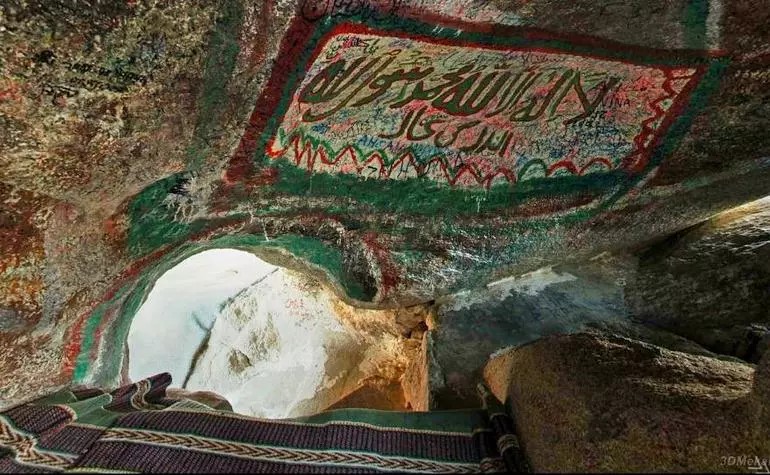
Ghar Thawr where Rasoolullah (s) and Sayyidina Abu Bakr as-Siddiq (r) stayed for three days after escaping the Quraysh.
The Prophet fled at night with Abu Bakr and left behind him Ali to impersonate him in his bed. On the way he stopped to hide in the Cave of Thawr. Abu Bakr said, “O Prophet, don’t enter, I will enter first.” In his heart he thought that there might be something harmful inside and he chose to encounter it first. He found a hole in the cave. He called the Prophet to come in and he put his foot over the hole. The Prophet came in and lay down with his head on Abu Bakr’s thigh. A snake inside the hole began to bite the foot of Abu Bakr. He tried not to move although he was in great pain. Tears flowed down his cheeks. One warm tear dropped on the blessed face of the Prophet . At this, as was mentioned in the Qur’an: “He said to his friend, Grieve not for verily Allah is with us.” [9: 40] and he also said, “What do you think of two when God is their Third?” [57: 5]. Abu Bakr said to the Prophet, “O Prophet of God, I am not sad, but I am in pain. A snake is biting my foot and I am worried that it might bite you. I am crying because my heart is burning for you and for your safety.” The Prophet was so pleased with the reply of his beloved Companion that he hugged Abu Bakr as-Siddiq , put his hand on his heart and poured the knowledge that Allah had given him into the heart of Abu Bakr as-Siddiq. That is why he said in a hadith, “Whatever Allah poured into my heart, I poured into the heart of Abu Bakr .”
Our Grandshaykh Muhammad Nazim al-Haqqani says, “Following this the Prophet put his other hand on the foot of Abu Bakr as-Siddiq and read, Bismillah ir-Rahman ir-Rahim, and the foot was immediately healed. Then he ordered the snake to come out and the snake came out, coiling itself in front of the Prophet . Then the Prophet said to the snake, ‘Do you not know that the flesh of a Siddiq is forbidden to you? Why are eating the flesh of my Companion?’ He replied to the Prophet in a perfect and pure Arabic, ‘O Prophet of Allah, were not all things created for your sake and for your love? O Prophet, I too love You. When I heard that Allah Almighty and Exalted said that the best nation is your nation, I asked Him to prolong my life and grant me the honor of being among your nation and looking at your face. And Allah granted me that wish and that honor. When Abu Bakr put his foot in that hole, it blocked my sight. I wanted him to move his foot to enable me to see you.’ The Prophet said, ‘Look at me now and fulfill your wish.’ The snake looked and looked; after a while, it died. The Prophet ordered the Jinn to carry the snake away and bury it.”
Mawlana Shaykh Nazim says, “These are secrets that have been given to the hearts of the Naqshbandi Saints.” He continues the story thus: “Then the Prophet said to Abu Bakr, ‘There was no need to stop in this cave, except that a significant event will happen here. The Light of the root of the spiritual Tree which is going to spread over all humanity, the Light coming directly from the Divine Presence, will appear here. Allah has ordered me to transmit it to you and to all the Naqshbandi Sufi followers.’
“This lineage was not called the Naqshbandi at that time, but was known as the Children of Abu Bakr as-Siddiq, and he was known to saints as the ‘Father’ of this line.
“Then Allah asked the Prophet to order Abu Bakr as-Siddiq to call all the Masters of the Golden Chain who are the inheritors of Abu Bakr. The latter called the Grandshaykhs of this Golden Chain, all of them, from his time down to the time of the Mahdi . All of them were called through their spirits from the World of Souls. Then he was ordered to call the 7,007 Naqshbandi Saints. Then the Prophet called the 124,000 prophets.
“Abu Bakr as-Siddiq, by order of the Prophet , ordered every grandshaykh to summon all his followers to appear spiritually. Then Abu Bakr as-Siddiq ordered all the Shaykhs to take the hands of their followers to receive initiation. He put his hand above them all, and then Muhammad put his hand above all of them, and then Allah put His Hand, the Hand of Power (Qudrat), over them all. Allah by Himself, put on the tongue of everyone present His recitation (talqeen adh-Dhikr), and He told the Prophet to order Abu Bakr as-Siddiq to order all the saints present with their followers to recite what they were hearing from the Voice of Power:
All of those present followed their Shaykhs and the Shaykhs followed what they heard the Prophet reciting. Then Allah Almighty and Exalted taught the secret of the Dhikr, known as Khatm-il-Khwajagan, to Abdul Khaliq al-Ghujduwani, who led the first dhikr among the saints of this Order. The Prophet announced to Abu Bakr, who announced to all saints, that Abdul Khaliq al-Ghujdawani is the leader of the Khatm-i-Khwajagan. Everyone was honored to receive that secret and light from Khwaja Abdul Khaliq al-Ghujdawani, in the presence of all saints, in the presence of Abu Bakr as-Siddiq, in the presence of The Prophet , in the Presence of Allah.
Mawlana Shaykh Nazim said, “Anyone who accepts initiation from us or attends our Dhikr must know that he was in the cave at that blessed time, in the Presence of the Prophet , and that he received all of these secrets then. These secrets have been transmitted to us from the masters of the Golden Chain, through Abu Bakr as-Siddiq.”
Abu Bakr as-Siddiq was overjoyed and astounded with what took place in that cave, and he understood why the Prophet had chosen him to be the companion of his migration. The Naqshbandi Shaykhs consider the events in the cave as the foundation of the Tariqat. Not only is it the source of the daily wird (devotion) but the souls of all members of the Order were present together at that time.
After the events in the cave, they continued on to Madinat al-Munawwarah. When they reached Quba, a village near Madinah, on a Monday in Rabi’ul Awwal, they stopped for several days. There the Prophet built the first mosque. They continued on their way on a Friday, after praying the Friday Prayer at Quba. It was the first Jum’a that he prayed. He entered Madinah with his friend, amid shouts of takbir (ALLAHU AKBAR) and tahmid (AL-HAMDU LILLAH) and the excited, joyful happiness of everyone. He moved to the place his camel stopped, and it is there that he built his mosque and his home. He stayed as a guest in the home of Abu Ayyub al-Ansari until his mosque was built.
When the Prophet came to Madinah, it was full of diseases. As soon as he arrived, the diseases disappeared. Following is a brief list of the main events of the next ten years.
Madinah Chronology
Year One – The Prophet was inspired to call the people to prayer by means of the human voice (Adhan).
Year Two – He was ordered to institute the monthly fast of Ramadan, and he was directed to face the Ka’aba in Makkah during prayers, instead of towards Jerusalem as they had done previously. It was the year that he fought the unbelievers in the decisive Battle of Badr.
Year Three – The Prophet fought the unbelievers at Uhud.
Year Four – The battle of Bani Nadeer took place, and permission was given for shortening the prayer during traveling and fighting. Alcohol was forbidden. Tayammum, or ritual purification with sand when water is not available, was allowed and the “prayer in fear” was authorized.
Year Five – The battle of Khandaq took place and the defection of Banu Quraizah and Mustaliq occurred.
Year Six – The Treaty of Hudaibiyya took place as did the Pledge of Loyalty — the model of Sufi initiation — under the Tree. The fifth pillar of the religion, the obligation of Hajj, also came in this year.
Year Seven – The battle of Khaibar took place.
Year Eight – The events of Mu’ta, the peaceful conquest of Makkah and the battle of Hunayn occurred.
Year Nine – The battle of Tabuk occurred and the Pilgrimage of as-Siddiq. It was called the Year of Wufud.
Year Ten – The Prophet made what is known as the Farewell Pilgrimage.
Year Eleven -The Prophet passed on to the other life.
Description of the Holy Prophet’s Features
Allah Almighty and Exalted adorned the Prophet with His Divine Lights and Manners, and then He added more by saying to him: “Truly you are of a magnificient nature” [68:4].
The Prophet was neither tall nor short, but he was of middle height. He had broad shoulders. His color was light, neither dark nor white. He had a broad forehead, with heavy eyebrows, not connected but with a blaze shining like silver in the middle of them. His eyes were large. His teeth were very white, like pearls. His hair was not curly nor was it straight, but in between. His neck was long. His chest was broad, without much flesh. The color of his chest was light, and between his sternum and his navel was a line of hair. He had no hair on his chest other than that line. His shoulders were wide and had hair on them. On his shoulders were two seals of Prophecy. All his Companions used to look at them. The right shoulder had a black beauty mark, and around it were some small hairs, like the hairs of a horse. His forearms were large. His wrists were long. His fingers were also long. His palm was smoother than silk. Whenever he put his hand on the head of a child or a man, the beautiful scent of musk came from it. Wherever he moved, a cloud moved with him that shaded him from the heat of the sun. His sweat was like white pearls, and its smell was like amber and musk. The Companions said they had never seen anything like it before.
The Holy Prophet used to look down more than he raised his head. Whoever saw him from afar was amazed by him and whoever knew him intimately loved him. He was most handsome both in his external appearance and his internal appearance.
Amr ibn al-`As said, “No one was dearer to me than the Holy Prophet nor was anyone more glorious than him in my eyes. So bright was his glory that I could not look at his face for any length of time, so that if I were asked to describe him I would not be able to as I had not looked at him long enough.”
The Prophet was the bravest among people, the most just and the most generous. He used to walk alone among his enemies at night without a guard. He was never afraid of anything in this world. He was the most modest of his person, the most sincere, and the most pious. He never spoke just to spend time. He preferred silence to speech and never showed pride, although he was the most eloquent speaker.
Allah gave the Prophet mastery in politics and mastery in private conduct. Although he didn’t write or read, Allah raised him from the land of ignorance, taught him the best of manners and the best of ethics.
He was the gentlest of men, the most tolerant, the most merciful, as Allah Himself called him “Kindest and Most Merciful” [9:128]. He smiled at everyone and joked with everyone in a decent way. Alone he was always crying and entreating Allah for forgiveness for his Ummah. He was always contemplating and meditating. He always used to sit to remember Allah by reciting Dhikr.
He used to walk with the widow and orphan. He showed humbleness to unbelievers, wishing them to become believers. Someone asked him “pray for Allah to curse the unbelievers.” He said, “I was not sent to curse but as a Mercy. I will ask for them to be guided because they don’t know.”
He called everyone to Allah. He never humiliated the poor. He was never afraid of a king. He always chose the easy way, according to Allah’s wish [2:185, 20:2]. He laughed without making a sound, not out loud. He always said, “serve your people.” He used to milk his goats, serve his family, patch clothes, walk sometimes barefooted, visit the sick, even if they were unbelievers or hypocrites, visiting the graves of believers and greeting them, training with the sword, learning the bow and arrow, riding the horse, riding the camel, riding the donkey. He used to eat with the poor and wretched. He always accepted a gift graciously, even if it was a spoonful of yogurt, and he used to reward it. He never ate from sadaqa (charity), but immediately passed it on to the poor. He never kept one dinar or one dirham in his house except he gave it to the poor. He never came home until he spent all that Allah had given him.
He was very good to his family and to his friends. He urged his friends to walk in front of him and walked behind them. He said, “leave my back for angels.” His companionship was the companionship of patience and shyness. Whoever argued with him saw patience from him, and he did not reply to those who insulted him. He never came against anyone in anger nor ever used bad language. He was never angry for himself and was only angry for his Lord’s sake. He used to eat with his servants. He never slapped anyone with his hand. He never punished for a mistake, but always forgave. His servant Anas () said, “In all my life, he never asked me once: why did you do this, or why didn’t you do that?”
The Clothes of the Holy Prophet
He used to wear whatever he found, cotton or wool, but mostly he used to wear cotton. He liked green clothes. Abu Huraira says, “He wore the long, loose shirts, the burda and the habra and the jubba, and he wore the turban with a face-veil and loose-ended, the izar and the rida’.” Jabir ibn Samurah says, “I saw the Prophet on a moonlit night. He had a red cloak over his body, and I looked attentively in turn towards him and the moon. Certainly, he appeared to me more beautiful than the moon itself.” He used to wear the white turban and the black turban and sometimes the red turban. He used to leave a tail at the back of his turban. Imam Tabari said “he used to have a turban of seven arms’ length.” He had a turban by the name of Sihab (the Clouds) which he gave to Ali . He used to wear a silver ring on his right hand, engraved with the words “Muhammadun Rasul-Allah.” He used to wear khuffs (leather socks) on his feet. He liked perfumes and fragrant scents.
He never saw ease and would not possess even a bed, as he wished to make his abode in the next world. His mattress was made from tree-leaves. He had a big cloak which he used to put on the floor and sit on. Sometimes he use to sleep on a reed mat or directly on the floor.
The Miracles of the Holy Prophet
He was a healer for himself and for others. He used to heal by reciting Qur’an on the sick person. He warned people to avoid too much eating. He performed countless miracles. He prayed that Ali not feel the hot and cold weather, and he never felt them. He prayed for Ibn `Abbas to be a genius in religion, jurisprudence, and explanation of Qur’an, which came to pass. When Qutada’s eye fell out of its socket, he put it back, and Qutada was able to see with it better than he ever had before. He rubbed the foot of Ibn Abi `Atiq when it was broken and it healed immediately. The moon split on his order as a sign to the unbelievers. Water sprang forth from his fingers from which a whole army drank and made ablution. From a small cup of water, water was pouring, making the desert like an oasis. The branch of a tree under which he sat, bowed in a gesture of love as he stood up to leave. The minbar (pulpit) at which he used to preach, used to give a moaning sound, as if crying for him. The stones praised Allah in his hand, so that everyone heard them. The animals complained to him. The deer and the wolf testified to his prophethood. He predicted that his daughter Fatima would be the first to follow him in death. He foretold Uthman Dhu-n-Nurayn, his third caliph and son-in-law, would be assassinated. He announced the murder of al-Aswad bin Annasi on the night of his death in Sana’a in far off Yaman. He mentioned the death of the King of Persia to his Companions on the exact moment that it happened. He ate meat full of poison, but nothing happened to him though the one who ate with him died immediately. Countless other miracles could be mentioned.
The Sayings of the Holy Prophet
No one can make a complete account of his sayings. Even if the seas of this world were ink and the trees were pens no one could write all the sayings of the Prophet Muhammad . Thousands and hundreds of thousands of his ahadith(narrated sayings) have been written from what he was saying and it was known as the `Ilm al-Hadith or Science of Prophetic Narration.
He said:
“Allah rewards people according to what they achieve.”
“Allah said, whoever comes against one of My saints, I will declare war against him.”
“Allah’s saints are under his domes. No one knows them except Him.”
“Be near the poor [meaning the spiritual poor] because they have a government of their own.”
“Be in this world as a stranger and a guest, and make the mosques your homes, and teach your heart leniency, and make much remembrance and cry much.”
“How many people welcome a day whose end they will not live to see, and expect a tomorrow which they do not reach?”
“Say the truth, even if to your detriment.”
“Make everything easy and don’t make it difficult. Give good tidings and don’t cause people to run away.”
“Allah said, ‘O Son of Adam, you will get what you have intended, and you will be with the one whom you love more.’”
“Keep Allah and He will keep you. Keep Allah before you. If you need help, ask His Help.”
“Be austere in this lower world and Allah will love you. Be austere with what is in the hands of people and the people will love you.”
“The one who has the most perfect mind is the one who is most fearful of Allah.
“Beware of the lower world because it is a black magic.”
“Refrain except from good speech.”
“Give back the Trust and don’t betray it.”
“When Allah loves someone, He will put him in difficulties.”
“When Allah wants good for His servant, He will guide him to someone that shows him the way.”
“Forgive, and Allah will forgive you.”
“Be merciful, Allah will be merciful with you.”
“The one under the heaviest punishment on the Day of Judgment is a fierce scholar.”
“The one under the heaviest punishment on the Day of Judgement is a scholar whose knowledge did not benefit him.”
“Ask Allah forgiveness and health.”
“Keep what you are doing secret.”
“The most sinful person is the one whose tongue is always lying.”
“All Creation is a servant of Allah. The most beloved to Him among them is the one that helped his brothers.”
“The best deed is when people will be safe from your tongue and your hand.”
“As long as you say ‘La ilaha ill-Allah’ (No god but God) it will lift Allah’s punishment from you and change you for the good.”
“O People, are you not ashamed that you collect more than you eat, and you build houses more than you need to live in?”
The Passing of the Holy Prophet
When Allah Almighty and Exalted perfected his Nation and completed His favor on His Prophet , He transferred him to a house better than his house, and to a Friend better than his friends. Allah Called his soul in his last days. As a result, his final sickness began in the last ten days of the month of Safar, in the house of his wife Maimuna . When his sickness intensified, he transferred to the house of `Ayesha . He was sick for twelve days. He used to send Abu Bakr as-Siddiq to lead the prayers as a sign to the Sahaba that he had chosen him as his successor.
He passed away on a Monday, the 12th of Rabi`ul Awwal. Wrapped in his nightgown, he was washed by Sayyidinas `Ali, `Abbas ibn `Abd al-Muttalib and his two sons, Qutham and Fadl. `Usama bin Zaid and Shakran were pouring the water which Aws Khazraji was bringing from the well. As they performed their washing, the body exuded beautiful scents, so that `Ali said continually: “By God, what would I give for you! How sweet you are and how wholesome you are, both alive and dead!” His male Companions entered his house one by one to pray on him, then the lady Companions prayed on him, then children prayed on him. He was buried in the same place he passed away, in the house of `Ayesha . Abu Talhah Zayd ibn Sahl dug his grave and those who washed him lowered his blessed body into it. Then it was covered and leveled and they threw water on it.
People were bereaved, tongues were silent. The world seemed darkened. No one knew what to say. The Holy Spirit — the angel Jibril – was no longer to come bringing revelation. The Prophet’s death was the greatest disaster for every Companion. Many people were crying and shouting. But Allah sent supporters for His religion, because that was the Seal of Prophets. He sent a Renewer (mujaddid) of this religion century after century. Saint after saint, we find that every grandshaykh of the Most Distinguished Naqshbandi Order was like a shadow of the Prophet , reviving the deen (religion) and training the seekers to find their Lord as the Companions had been trained.
The secret of God’s strong support and pure guidance passed from Muhammad to his beloved friend, Abu Bakr as-Siddiq . What the Prophet poured into the heart of Abu Bakr no one knows. May Allah send upon our Prophet more and more of His Light! He was sent as a Mercy for human beings and his secret passed from one saint to another to support this religion and to bring his secret to the hearts of human beings.